Dialogues of Meaning-Making part 1: A letter to Nealob
February 03, 2024
Dear Nealob,
I have been enjoying our co-working time together in the 10c library. We overlook people skating at city hall (and sometimes skate ourselves!), hear the buzz of other community builders milling around us, and smell the butter from croissants wafting up from the bakery next door (yum!). Sharing these experiences has become a cherished part of my QE experience. Starting these letters was inspired by Robyn Maynard and Leanne Betasamosake Simpson and their book, Rehearsals for Living (2022), in which they exchange a series of letters exploring Black and Indigenous perspectives on our current social, economic, and political reality which has been/is profoundly and shaped by slavery and colonization. For Maynard and Simpson, letter writing is a kinship and meaning-making practice. Together they co-create new knowledge while reimagining and re-building an alternative, more just world.
I hope we can extend our physical practice of being with each other within these letters by creating a relational space on the page. A space that holds the messiness of our learning. A space where we can get a feel for the topography of our respective fields and discover where we stand (even if that place is temporary, contingent, or even unsettled). A space to develop our critical praxis – the bringing together of theory, practice, and reflection to enact change in the world (Freire, 1972).
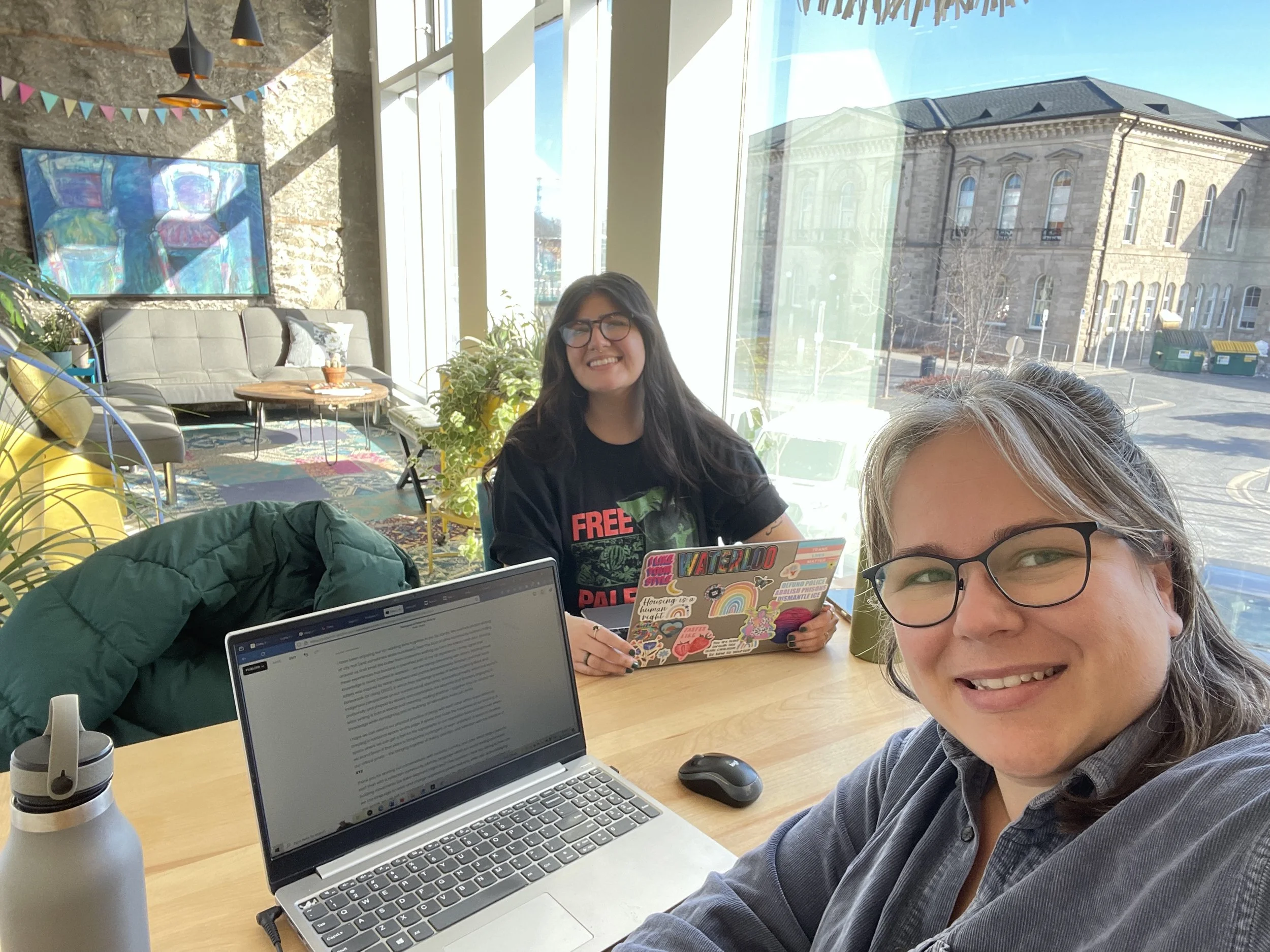
A photo of Nealob and I working on a sunny afternoon.
Thank you for starting our conversations with curiosity, humility, and care. What better place to start than with a reflection community, identity, and language within our world-ending and world-building movements (as Robyn Maynard might say)? One question I hear you asking is, how can we use language to resist and change oppressive power relations, while also acknowledging any words we use will be contingent, incomplete, and insufficient to capture the complexity of lived experiences? This is something I’ve been thinking through as well.
The words we use can help describe and create a world in common. A world of shared values, attitudes, beliefs, and experiences. But our words can also homogenize, flatten complexity, and render agentic, vibrant subjects into static, passive objects. Language is often used as a tool of oppression because it can obscure, deny, and invisibilize diverse epistemologies and ontologies. No wonder it is so hard to find the “right words.” As you described in your letter, we are following a tradition of feminist, critical Indigenous, and queer scholars/activists who have been grappling with these questions long before us.
Navigating faught terrain
One insight that might be helpful comes from Max Liboiron (mediasanctuary, 2021) and the concept of “fraught terrains,” which is a metaphor Max uses to describe spaces without a clear path forward, where accountabilities are complex and uncertain. Max argues that we are all navigating fraught terrain in our social change work and should take a position against a politics of purity, or the idea that “our actions and intentions can and must be devoid of compromise and contamination” (mediasanctuary, 2021). For Max, purity politics are another expression of terra nullius, or the idea that there are unblemished and untouched spaces (mediasanctuary, 2021). All of our lives, to different degrees and with different effects, are structured by colonialism, heteropatriarchy, and racism. Max also draws on Charles Hale’s (2006) use of compromise, arguing that if you're trying to enact change while working within a harmful system (and we are all working within harmful systems to some extent), you're going to reproduce parts of that system even while working to change it. If there is no unblemished starting place and some compromise is necessary in our change work. This makes me wonder if our search for the “right words” is so perplexing because… there are no right words.
“You don’t get to choose the ground you stand on, and often that ground is kind of crappy. This is the basis for collaboration in the world. ”
Max argues that understanding how to navigate fraught terrain as scholars and practitioners is a methodological question (mediasantuary, 2021). They call on us to carefully consider how our practices might reproduce the system we are trying to change, whether those practices need to be maintained (out of necessity or strategy), or if there is an opportunity for disruption (mediasantuary, 2021). This reminds me of Donna Harraway’s (2016) call to “stay with the trouble” of entanglements (or, in this case, fraught terrains) rather than falling for the temptation to focus on the future. We are living with these inheritances today - there is urgent work to do so we can “live and die well with each other in a thick present” (pg. 1).
Both Harraway and Max urge us to pay close attention to the complexities, dilemmas, and uncertainties of the here and now. To make careful choices in our attempts to disrupt harm, to learn from our inevitable mistakes, and to share those learnings with others. So maybe this answers your question about frogging? Perhaps, rather than pulling everything apart and starting from scratch, you might stay with the trouble of language a little bit longer. Because chances are, even if you start over, you might find yourself in a similar place.

Image of stones packed tightly together but with deep dark crevasses between them. This photo made think of Max’s metaphor of a fraught terrain.
An ethic of incommensurability
I am also reminded of Tuck and Yang’s (2012) use of what they describe as an “ethic of incommensurability.” An ethic of incommensurability describes “incompatible ideas of what is good” and helps us “recognize what is distinct and what is sovereign for project(s) of decolonization in relation to human and civil rights-based social justice projects” (Tuck and Yang, 2012, pg. 28). As an analytic, incommensurability helps us to “recognize differences without conflating them, without smoothing them over, and without minimizing or abandoning them” (mediasancturary, 2021). Inherently unsettling, an ethic of incommensurability also helps us identify opportunities for “strategic and contingent collaborations” and the reasons why “lasting solidarities” between different movements may be “elusive, even undesirable” (Tuck and Yang, 2012, pg. 28). I wonder if part of your hesitations regarding language could be resolved by identifying which social justice projects/movements can be brought together in solidarity (even contingently), and which projects are incommensurable?

A blurry image of blue water and waves. To me, this image represents the feeling of being unsettled.
Using and troubling a category simultaneously
Differences make a difference, and we can’t paper or gloss over them. But how do we keep them in “complex relationship” (mediasanctuary, 2021)? There is another conversation we can trace that might help us think this through. Patti Lather is grappling with the implications of terminology and how words (in her case, scientificity and scientism) open and/or foreclose possibilities for change. She turns to the work of Judith Butler (2004) who contends that when “the excluded speak to and from a category, they open up the category to a different future” by “contesting the power that works in and through it” (p. 13; Lather, 2005, pg ). Lather (2005) comes to see how “putting one’s necessary categories in crisis can help us see how such categories work across time and what they exclude” (pg. 2). She goes on to advocate for “using and troubling a category simultaneously,” which leads to a kind of “permanent unsettlement” where “disorientation, openness, and unknowingness are part of the process” (Lather, pg. 2). Michelle Fine, Eve Tuck, and Sarah Zeller-Berkman (2008) pick up this conversation and apply the concept of “using and troubling a category simultaneously” to create ethical interventions into trans-local policies that affect Indigenous peoples and their places. They acknowledge that sometimes, we need to adopt hegemonic language strategically - but when we do, it needs to be done critically and to “always hold a space open for difference and rely on local knowledge to fill in” (pg. 165).
The concept of using and troubling a category also applies to my work. My research contributes to a growing movement that aims to support Indigenous governments in advancing Indigenous-led approaches to nature conservation. But Indigenous-led conservation is an oxymoron. The concepts at the foundation of nature conservation are completely at odds with “Indigenous land-connected practices and longstanding experiential knowledge that inform and structure our ethical engagements with the world and our relationships with human and nonhuman others over time” (Coulthard, 2014, pg. 13). Around the world, colonial powers have imposed the North American model of conservation, often referred to by Indigenous peoples and scholars as fortress or colonial conservation, to order and control how humans relate to non-human life (Neumann, 2013). In Canada, Crown governments and settler-led conservation organizations have used colonial conservation discourse, practice, and structures to displace Indigenous peoples, and obtain land to advance settler goals while legitimizing the state (Braun, 2002; Sandlos, 2007; Youdelis et al., 2020).
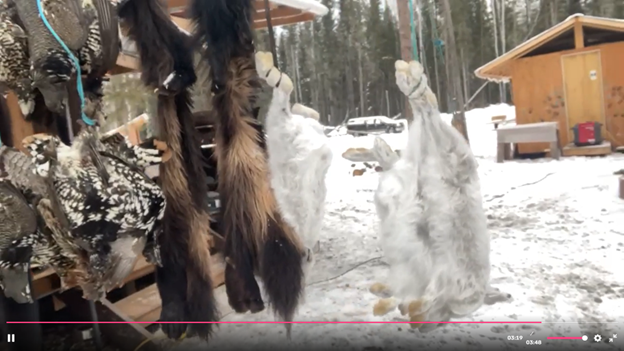
This is a screenshot of a video Chloe Dragon Smith shared. She is showing a harvest with partridge, rabbits, and wolverines from their cabin in the woods.
Despite this, Indigenous leaders, governments, and organizations increasingly use the language of Indigenous-led conservation to advance strategic goals. My friend and collaborator Chloe Dragon-Smith is of German, Dënesųłiné, Métis, and French heritage. She is working hard to reclaim traditional life-ways by living in the bush in Wood Buffalo National Park, the traditional territory of her family and the family of her partner, Robert. Chloe likes to say that Indigenous-led conservation is a kind of Trojan horse. It’s a way of using the language of settler society while subverting it to advance decolonial practices (personal common. January 19, 2024) .
Feeling our way

Image of a philodendron leaf casting a heart-shaped shadow on a wall.
Returning to the idea that we must make space for local knowledge, I will end my response to your letter by returning to your hesitations about the language you use to describe yourself in relation to your doctoral work. Nealob, you are at the heart of your work. You are inside the research in a very intimate way. When you feel lost amongst the voices of all the scholars you’re engaging with as part of your QE, I will gently urge you to lean into your own felt knowledge.
Dian Million (2009) argues that feelings are theory because they offer important insights into lived experiences (pg. 61). Moreover, feelings are never only an individual experience because they are “culturally mediated forms of knowledge” (Million, 2009, pg. 61). This embodied or felt knowledge is disruptive: it breaks down divisions between “the private and public, the micro and the macro . . . illustrating how social structures are an outcome of [e]motionally [e]mbodied [p]ractices” (Million, 2009, pg. 71). Million draws on stories created by Indigenous feminists like Lee Maracle to illustrate how felt knowledge of settler colonialism is often communicated through stories as a practice which either “reifies settler colonial structures or offer an ‘otherwise’ as a powerful tool for social change” (Million, 2014, pg. 72).
So, after this reflection about fraught terrains, compromise, incommensurability, and contingency… maybe the place to start is with you and your story.
Works Cited
Braun, B. (2002). The intemperate rainforest: Nature, culture, and power on Canada’s west coast. University of Minnesota Press.
Butler, Judith (2004) Undoing Gender. NY: Routledge.
Coulthard, G. (2014). Red Skin, White Masks: Rejecting the Colonial Politics of Recognition. University of Minnesota Press.
Fine, M., Tuck, E., & Zeller-Berkman, S. (2008). Do You Believe in Geneva? Methods and Ethics at the Global-Local Nexus. In Denzin, N. K., Lincoln, Y. S., & Smith, L. Tuhiwai (Eds.). Handbook of critical and Indigenous methodologies. Sage Publications.
Hale, C. R. (2006). Activist research vs. cultural critique: Indigenous land rights and the contradictions of politically engaged anthropology. Cultural anthropology, 21(1), 96-120.
Haraway, D. J. (2016). Staying with the Trouble. Duke University Press.
Lather, P. (May 5-7, 2005). Scientism and Scientificity in the Rage for Accountability: A Feminist Deconstruction. [Paper presentation]. First International Congress of Qualitative Inquiry, Champaign, Illinois, USA.
mediasanctuary. (October 23, 2021). Dr. Max Liboiron at Ruderal Ecologies 2 "Methodologies in Fraught Terrain”. [Video]. https://www.youtube.com/watch?v=oiKeaStJS48&list=PLUZXBFEJsV9- qCttle6APCMsVbp9bGYtO&t=816s
Maynard, R. & Betasamosake Simpson, L. (2022). Rehearsals for living. Penguin Random House Canada.
Million, D. (2009). Felt theory: An Indigenous feminist approach to affect and history. Wicazo Sa Review, 24(2), 52-76. http://doi.org/10.1353./wic.0.0043.
Million, D. (2014). There is a river in me: Theory from life. In A. Simpson & A. Smith. (Eds.), Theorizing Native studies. Duke University Press.
Neumann, R.P. (2013). Churchill and Roosevelt in Africa: Performing and writing landscapes of race, empire and nation. Annals of the Association of American Geographers, 103(6), 1371-1388.
Sandlos, J. (2007). Federal spaces, local conflicts: National parks and the exclusionary politics of the conservation movement in Ontario, 1900-1935. Journal of the Canadian Historical Association, 16(1), 293-318. doi:10.7202/015735ar.
Tuck, E. & Yang, W. (2012). Decolonization is not a metaphor. Decolonization: Indigeneity, Education & Society. 1(1), 1‐40.
Youdelis, M., Nakoochee, R., O'Neil, C., Lunstrum, E., & Roth, R. (2020). "Wilderness" revisited: Is Canadian park management moving beyond the "wilderness" ethic? Canadian Geographer-Geographe Canadien, 64(2), 232-249. doi:10.1111/cag.12600.